

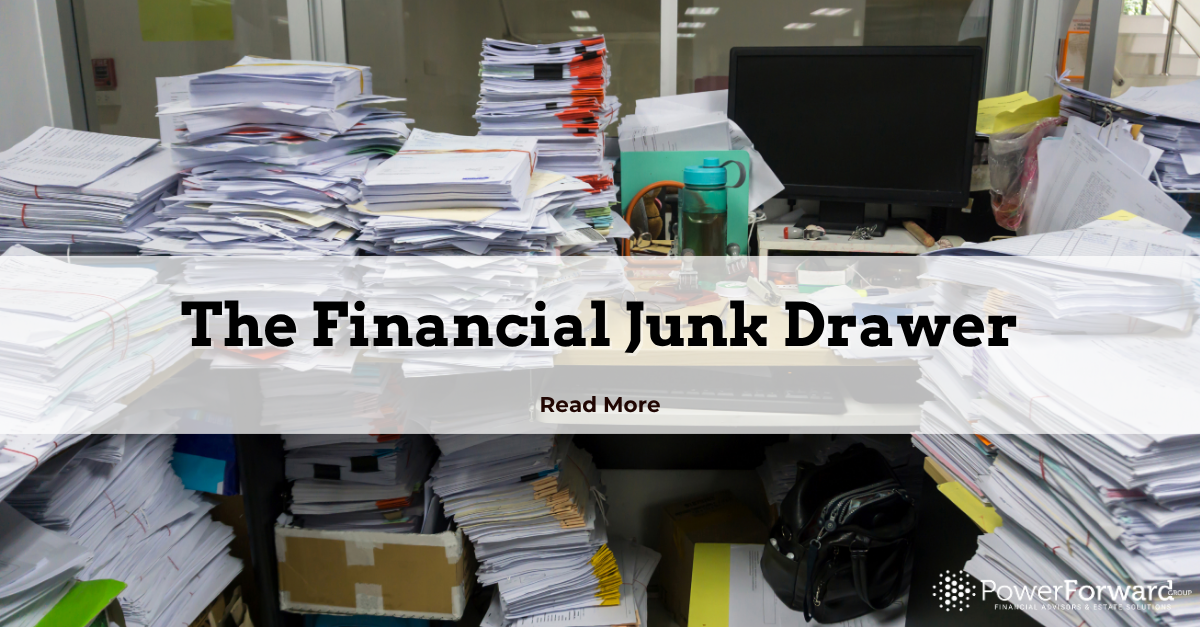
The Financial Junk Drawer
We all have one at home, the infamous “junk-drawer”. Filled with everything from unsharpened pencils, screws you don’t what for, and pens with no ink but every time you try to use them you just throw back in the drawer anyway.
For many Big Law Partners, their finances look exactly the same. Not because they’ve been careless. In fact, it’s usually the opposite. They’ve been responsible. They’ve saved, invested, bought insurance, & maxed out retirement plans.
And yet, despite having made all of these smart financial moves, things feel…….scattered.
What a “Junk Drawer” Financial Life Actually Looks Like
It’s not obvious chaos and frankly rarely feels like a problem, to some degree.
- An old 401(k) from a previous firm that hasn’t been touched in years
- A brokerage account opened during a market dip
- Another account at a different firm because someone made a compelling pitch
- A life insurance policy from when your first kid was born
- A current 401(k) or cash balance plan being funded automatically
On their own? Smart financial decisions.
Collectively? Disconnected.
Most people don’t feel like anything is wrong, but they also don’t feel like everything is on the same page working together. And that’s where the real problem starts.
What Actually Causes This (It’s Not Just “Not Having an Advisor”)
The simple answer is, “They don’t have a financial advisor.” But that’s not the full story. Here’s what’s really going on:
1. Decisions Made in Isolation
Most financial decisions happen at different points in life:
- “I need to start saving” → open a 401(k)
- “I should invest more” → open a brokerage account
- “I should protect my family” → buy insurance
Each decision solves a moment-in-time problem.
But no one is stepping back and asking, “How do all of these decisions fit together over the next 20–30 years?”
2. Advice That’s Fragmented by Design
Even Big Law Partners often have:
- A CPA focused on tax filing
- An advisor focused on investments
- An insurance agent focused on protection
Each role operates in its own lane & no one is responsible for coordination. So, what happens? You end up with a collection of “good” strategies that were never designed to work together.
3. Success Masks the Problem
If you’re earning well, saving consistently, and your accounts are growing. There’s no immediate pain, no red flags, & no emergencies.
Which creates a dangerous assumption, “if nothing feels broken, it must be fine.”
Why People Don’t Fix It (Even When They Feel Something’s Off)
This is where it gets human. Because most people do have a sense, at some level, that things could be more organized. But they don’t act or make changes. Not because they’re lazy. Because of real, understandable reasons.
1. Time is Scarce
If you’re billing 10–12 hours a day, commuting, & taking care of kids. Reorganizing your financial life falls to the bottom of the list. We all have the same 24 hours in the day, so it’s not that you don’t have the time, it’s that this is not a priority.
It’s not urgent. It’s not screaming for attention. So it gets pushed off.
2. Fear of Opening Pandora’s Box
There’s a quiet hesitation, “If I really dig into this… am I going to find things I should’ve been doing differently?” That uncertainty alone can be enough to delay action.
3. Inertia (The Hardest Force to Overcome)
Even if things aren’t optimized, they’re familiar. Accounts are set up, money is flowing, & nothing feels broken.
Making a change feels like:
- Transferring accounts
- Reviewing everything
- Potentially second-guessing past decisions
So people stay where they are, not because it’s best, but because it’s easiest.
4. Loyalty & Relationships
Many people have long-standing relationships:
- A family friend as an advisor
- A CPA they’ve used for years
Even if those relationships aren’t solving everything, there’s hesitation to disrupt them.
The Real Cost of a “Junk Drawer” Financial Life
This is where it becomes tangible. Because while nothing may feel wrong today, the inefficiencies are real, and they compound over time.
1. Overlapping Investments
Without coordination:
- You may have the same exposures across multiple accounts
- You might think you’re diversified… but you’re actually overly concentrated
This can quietly increase risk without increasing return.
2. Tax Inefficiencies
This is one of the biggest hidden gaps.
When accounts aren’t working together:
- Assets may be in the wrong account types (taxable vs. tax-advantaged)
- Gains may be realized unnecessarily
- Opportunities like Roth conversions or loss harvesting may be missed
Over time, this doesn’t just reduce returns, it reduces what you actually keep.
3. Missed Strategy Windows
Certain strategies only work during specific windows:
- Lower-income years
- Transition periods
- Pre-retirement phases
If no one is proactively mapping this out, those windows come and go, unnoticed.
4. Cash Flow Disconnect
Especially for professionals with complex income (like K-1 earners):
Without coordination:
- You may over-save in one area while under-saving in another
- You may not be optimizing liquidity vs. long-term growth
- Tax reserves may not be aligned with actual obligations
The Emotional Impact (The Thing You May Share with Your Uber Driver but Not Your FA)
Beyond the numbers, this is where it really shows up.
Even high earning Partners, people who should feel financially confident, often feel:
- A low-level stress: “I think I’m doing the right things… but I’m not 100% sure.”
- Uncertainty: “Am I missing something?”
- Lack of clarity: “If I wanted to make a big decision, how would everything fit together?”
It’s not panic but it festers and it’s real.
What Changes When Things Are Actually Coordinated
This isn’t about having more accounts, or fewer accounts. It’s about having a strategy that connects everything.
A Strategy Where:
- Investments are aligned with a tax plan
- Accounts are positioned intentionally
- Decisions are made in the context of a multi-year strategy, not just isolated moments
And most importantly, you go from asking “Am I missing something?”. To knowing exactly how each piece fits.
The Final Verdict?
A junk drawer isn’t a problem, until you actually need something from it. You dig and dig around looking but it turns out your wife got rid of it months ago (spoiler: she told you about it too)!
The same is true with your finances. When everything is siloed, it works… until it doesn’t. And by the time the inefficiencies show up in a meaningful way, they’ve often been compounding for years.
The goal isn’t to start over. It’s simply to take what you already have and make sure it’s finally working together.
8864878RG_Apr28
